Surveys

Explore free marketing survey templates, sample questions, and customer research tips to understand your audience, improve campaigns, and make smarter marketing decisions.
October 27, 2026
A small online store has been running ads for months. The team regularly discusses campaign performance, tests new headlines, and offers discounts. Clicks are coming in, but sales remain flat. Everyone has a theory about the problem, but nobody knows what customers actually want.
Then someone sends a short survey to recent buyers. The answers reveal something unexpected: many customers discovered the store through recommendations, and reliable delivery matters more to them than discounts.
That information gives the team a clearer direction for its next campaign.
This is where marketing surveys can make a difference. Website analytics show what people do, but surveys help explain why they do it. With the right questions, businesses can better understand customer preferences, buying decisions, brand awareness, and content interests.
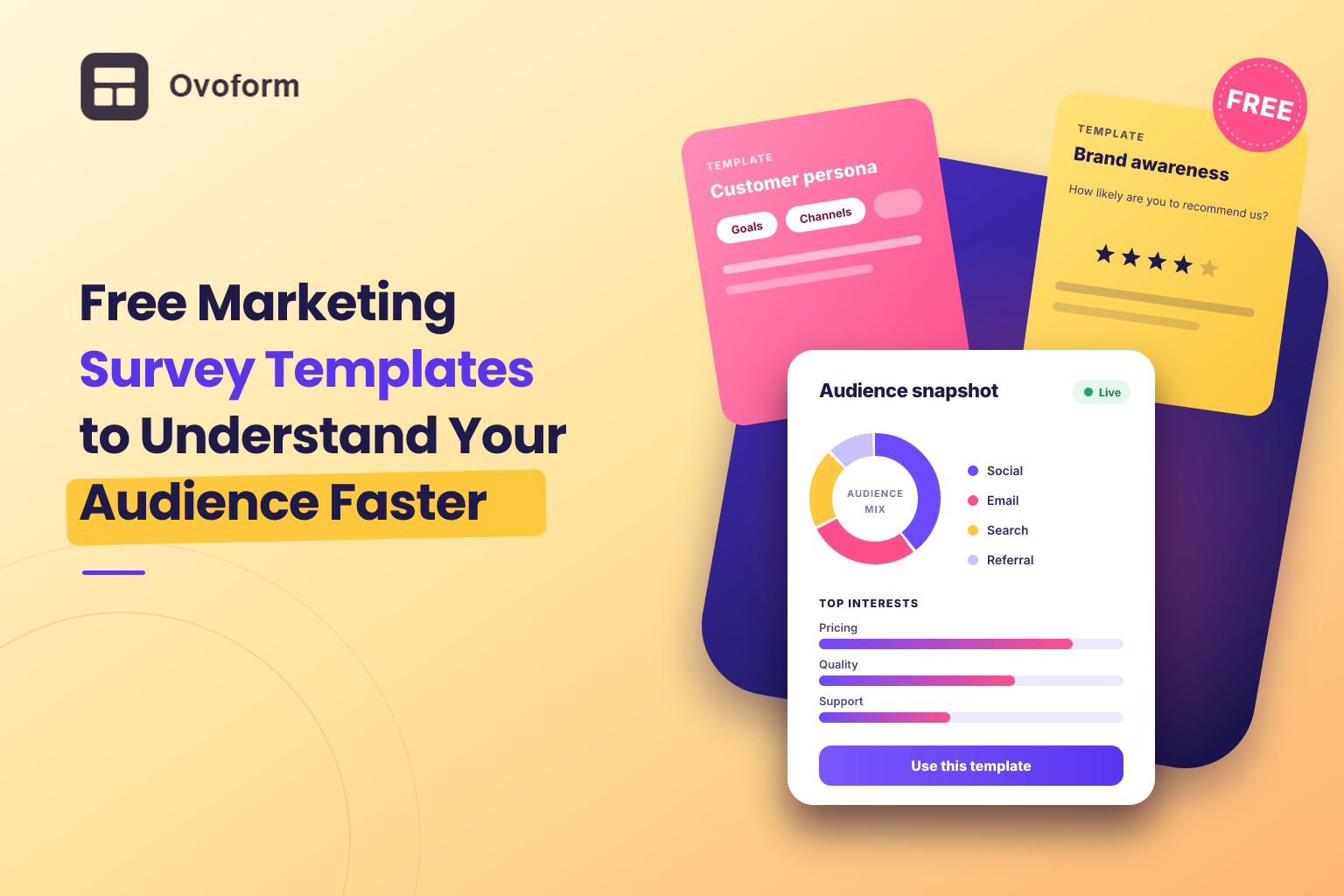
Marketing survey templates make the process easier by providing a starting point instead of leaving you to write every question from scratch. This guide covers useful template types, ready-to-adapt marketing survey questions, practical examples, and ways to turn responses into better marketing decisions.
A marketing survey template is a reusable set of questions designed to answer a specific marketing question. You might use one to learn how customers found your business, why they chose your product, what content they prefer, or how they experienced a recent campaign.
A customer research survey template typically focuses on purchasing behavior, customer needs, and barriers to buying. An audience research survey explores interests, challenges, preferences, and the channels people use. A campaign feedback survey evaluates a particular marketing activity.
These templates can be adapted for ecommerce stores, SaaS companies, service businesses, agencies, creators, and other organizations.
The important thing is to choose a template based on what you need to learn—not simply because it contains a large number of questions. For inspiration, browse these 20 online survey templates for small businesses and select a format that matches your objective.
Marketing teams have access to more performance data than ever, but numbers alone rarely tell the whole story.
For example, a high bounce rate might indicate that a landing page is not meeting visitors' expectations. Analytics can show where visitors leave, while a short survey may reveal that the pricing is unclear or the page does not explain the product's benefits.
Customer surveys can help businesses:
Understand buying decisions: Discover what convinced customers to purchase and what nearly stopped them.
Improve messaging: Learn the words customers use to describe their needs and problems.
Choose better content topics: Identify questions, challenges, and formats that matter to the audience.
Evaluate marketing campaigns: Find out whether an email, webinar, promotion, or advertisement was useful.
Identify customer experience problems: Understand recurring frustrations before they become larger issues.
Surveys work best alongside other evidence, such as sales figures, website analytics, support conversations, and customer interviews. They add context to the numbers rather than replacing them.
You do not need to run every type of survey. Start with the one that will help you make your next important decision.
Use an audience research survey to understand who your audience is, what they care about, and where they look for information.
Useful questions include:
What best describes your role or occupation?
What is the biggest challenge you are currently trying to solve?
Which platforms do you use to find advice or recommendations?
What topics would you like to learn more about?
This template is particularly useful before launching a content strategy, entering a new market, or refining customer personas. Ask only for personal details that serve a clear purpose.
A customer research survey helps you understand why people buy, or why they decide not to.
Try asking what problem they wanted to solve, which alternatives they considered, what influenced their final decision, and what nearly prevented them from purchasing.
These answers can reveal useful language for landing pages, product descriptions, sales emails, and advertisements. They can also uncover objections that your current marketing does not address.
For a more detailed approach to researching customer needs, read this guide to market research surveys.
A brand awareness survey helps you understand whether people recognize your business and how they discovered it.
Ask respondents which brands they associate with a particular product category, whether they have heard of your business, and where they first encountered it.
This can help you assess whether your marketing is building recognition beyond immediate clicks or conversions. When possible, compare responses from existing customers with those from people who have not purchased.
After an email campaign, webinar, product launch, or promotion, ask a few questions about the experience.
For example, was the message clear? Was the offer relevant? What information was missing? What would make a future campaign more useful?
Campaign feedback can reveal problems that open rates and click-through rates cannot explain. Send the survey while the experience is still fresh, and keep the questions focused on the specific campaign.
A content marketing survey helps you plan articles, videos, newsletters, social posts, and educational resources around genuine audience interests.
Ask which topics people struggle with, which formats they prefer, how frequently they want updates, and what questions they have not found answers to.
Do not assume that a preference automatically predicts engagement. Use survey results to develop ideas, then compare them with actual content performance to see what resonates.
A customer satisfaction survey measures how people feel about a purchase, service, delivery, or support interaction.
You might ask respondents to rate their experience, identify what went well, and describe one improvement that would matter to them.
Keep the survey specific to the experience being measured. A survey sent after customer support should focus on the support interaction, not ask customers to rate every aspect of the business.
You can find more question ideas in this collection of 45 customer satisfaction survey questions.
Use this template when evaluating a new feature, product idea, service package, or proposed improvement.
Ask what customers currently use to solve the problem, which features matter most, and what concerns they would have before trying the proposed solution.
Avoid asking only whether someone likes an idea. People may express interest without ever buying it. Where appropriate, investigate current behavior, willingness to switch, and the conditions that would influence a real purchase.
The best marketing survey questions are easy to understand and connected to a decision you need to make. Here are examples you can adapt for your own customer research survey.
Marketing objective | Sample question | Suggested format |
|---|---|---|
Discovery | How did you first hear about us? | Multiple choice |
Purchase motivation | What made you choose us? | Short answer |
Buying barriers | What almost stopped you from purchasing? | Short answer |
Customer needs | What is the biggest challenge you face with this task? | Short answer |
Brand awareness | Which brands come to mind for this type of product? | Open answer |
Content planning | Which topics would you like us to cover? | Multiple choice |
Content format | Which format do you prefer? | Multiple choice |
Campaign relevance | How relevant was this message to your needs? | Rating scale |
Offer clarity | How clear was the offer presented to you? | Rating scale |
Product feedback | Which feature do you find most useful? | Multiple choice |
Customer satisfaction | How would you rate your recent experience? | Rating scale |
Service improvement | What is one thing we could do better? | Optional short answer |
Purchase intent | How likely are you to consider this product? | Rating scale |
Customer loyalty | How likely are you to recommend us to someone you know? | 0–10 scale |
Follow-up research | Would you be willing to answer a few follow-up questions? | Yes / No |
Do not place all 15 questions in one survey. Select five to eight that address one objective, and remove anything that will not influence a decision.
Also, avoid leading wording. Instead of asking, “How much did you love our new product?” ask, “How would you describe your experience with our new product?” Neutral questions make the results more useful.
Timing influences both response rates and the quality of the information you collect.
After a purchase: Ask customers what influenced their decision while they still remember the details. This is a useful time to explore buying motivations and concerns.
After a campaign or webinar: Send a short campaign feedback survey within a day or two. Ask about clarity, relevance, and what could be improved.
Before launching something new: Use an audience or product research survey to explore customer needs before committing significant time and budget. Treat the results as evidence to investigate, not proof that people will buy.
During customer onboarding: Ask new users whether they understand the next steps and whether anything is preventing them from getting started.
Every quarter: A brief audience survey can help you notice changing priorities, content preferences, or emerging challenges.
There is no need to survey everyone every month. Choose a moment when people can answer meaningfully and when your team can use the results.
Even a well-designed template can produce poor data if people find the survey confusing or intrusive.
Keep it short. Five to eight focused questions are a reasonable starting point. Longer research projects may require more, but explain why the additional detail matters.
Make the purpose clear. Tell respondents why you are asking and how their feedback will be used. A clear introduction gives people a reason to participate.
Use the right response format. Multiple-choice questions are useful for common options, rating scales help measure perceptions, and open-ended questions reveal details you may not have anticipated.
Make personal questions optional. Avoid asking for sensitive or unnecessary information. Collect only what you need and explain how responses will be handled.
Use conditional questions where helpful. If a customer gives a low rating, show a relevant follow-up asking what went wrong. If they report a positive experience, ask what worked well instead. Keep the survey relevant to each respondent.
Test the survey on a phone. Check that questions are readable, options are easy to select, and the form works as expected before sharing it widely.
Close the feedback loop. If respondents suggest a change and you implement it, let them know. Even when a suggestion cannot be adopted, explaining the reason can help maintain trust.
For more practical examples, explore these customer feedback survey templates and adapt the wording to the experience you want to measure.
A survey does not become useful simply because many people complete it. The quality of the questions and the way you interpret the answers matter just as much.
Trying to learn everything at once: Separate audience research, customer satisfaction, and campaign evaluation when they serve different goals.
Surveying only happy customers: Include a balanced mix of recent buyers, repeat customers, inactive users, and other relevant audience segments.
Combining two questions: Asking whether the price and quality were satisfactory makes it difficult to identify which factor influenced the answer.
Treating opinions as guaranteed behavior: A respondent who says they like a product idea may not actually purchase it.
Ignoring the sample: Responses from a small or unrepresentative group may not reflect your whole audience. Be cautious about generalizing the results.
Collecting data without acting: Decide in advance who will review the findings and what decisions the survey could inform.
Survey results are clues, not automatic instructions. Look for patterns, compare them with other evidence, and investigate surprising findings before making major changes.
Collecting responses is only the beginning. The value comes from using the answers to improve something.
Start by grouping open-ended responses into recurring themes. For example, customers might mention delivery speed, confusing pricing, limited product choices, or difficulty getting support. Keep a separate category for unusual comments that do not fit the main patterns.
Next, compare those themes with existing business data. If customers say delivery is a concern, review delivery-related support requests and repeat-purchase rates. If they want more educational content, test a few relevant topics and monitor engagement.
Then choose one practical action. You might rewrite a confusing section of your landing page, explain an offer more clearly, or create a guide that addresses a common customer question.
Record what you changed and what happened afterward. This makes future surveys more valuable because you can compare findings over time rather than treating each survey as an isolated exercise.
If you track satisfaction or recommendation scores, use the same question and calculation method when comparing results. The NPS calculator can help you understand how a Net Promoter Score is calculated. Remember that a single score does not explain why customers feel the way they do, so pair it with follow-up questions when useful.
You can create a useful survey without a complicated research process.
Choose one objective. Decide whether you need to understand buying behavior, evaluate a campaign, measure satisfaction, or plan content.
Choose a suitable template. Start with a structure designed for that objective rather than adding unrelated questions.
Adapt the wording. Use language your customers understand and remove questions that do not apply to your business.
Select the right audience. Send the survey to people who can answer the questions based on their actual experience.
Test before sharing. Complete the survey yourself and check the mobile experience, answer options, and confirmation message.
Organize the responses. Review ratings and multiple-choice results, then group written answers into useful themes.
Take one clear action. Use the findings to improve a campaign, page, product, or customer experience.
Review the impact. Check whether the change helped and decide whether another survey or a different source of evidence is needed.
If you want a starting point, Ovoform offers customizable survey and feedback forms that can be adapted for different marketing goals. You can explore its analytics features to learn more about analyzing form responses and making better use of collected data.
Marketing works better when decisions are informed by customers rather than assumptions. The right marketing survey template helps you ask clearer questions, understand customer needs, and discover why people respond to your products, messages, and campaigns.
You do not need a large research project to begin. Choose one objective, ask a handful of relevant questions, and share the survey with the right audience. Then review the responses, compare them with other evidence, and make one meaningful improvement.
Over time, this simple habit can help you develop more relevant content, improve customer experiences, and build marketing campaigns that reflect what people actually care about.
Create surveys, FAQs, and feedback forms in minutes with Ovoform — no code required.
Get started freeStart building with Ovoform today — free forever, no credit card required.
Get Started For Free