Surveys

Market research surveys help businesses collect customer insights, validate decisions, and reduce guesswork across product development, marketing, pricing, and customer experience initiatives. By choosing the right survey type, using effective research methods, and asking clear, unbiased questions, organizations can gather reliable data that drives smarter business decisions. This guide covers survey types, research methods, question-writing best practices, real-world examples, and practical steps to help businesses design effective market research surveys and turn customer feedback into actionable growth opportunities.
Ovoform Team
June 25, 2026

Every business decision you make is a bet. The question is whether you are placing that bet with real information or just a gut feeling. Market research surveys are how smart marketing and product teams stack the odds in their favour. They are the structured, repeatable process of asking the right people the right questions and turning the answers into decisions that actually work.
This guide covers everything you need to know about market research surveys, the different types and methods available, how to write questions that generate useful data, and the real-world examples that show what good practice looks like. Whether you are a brand manager at a mid-size consumer company or a growth marketer at a fast-moving SaaS business, this guide will help you build a survey strategy that produces insights you can actually use.
A market research survey is a structured questionnaire used to collect feedback, opinions, behaviors, preferences, and customer insights from a target audience. Businesses use market research surveys to make informed decisions about products, pricing, marketing, customer experience, and business strategy.
Unlike website analytics or sales reports, surveys help explain why customers behave the way they do, giving organizations a deeper understanding of their market. A well-designed survey provides both quantitative and qualitative data, helping teams validate assumptions and uncover growth opportunities.
Managing customer relationships, product development, and marketing decisions becomes significantly easier when businesses understand what their audience actually thinks. Market research surveys provide that clarity.
The businesses that win are usually the ones that understand their customers better than their competitors do. Market research surveys are one of the most practical tools for building that understanding.
Here is what they help you do:
Reduce guesswork before launching a new product or feature
Identify why customers churn and what keeps loyal customers coming back
Test messaging and positioning before you spend money on paid campaigns
Benchmark satisfaction scores over time so you can track whether changes are working
Give sales and customer success teams the context they need to have better conversations
A global consumer goods brand like Unilever runs regular brand perception surveys across markets before adjusting product formulations or advertising creative. A SaaS company like Notion runs post-onboarding surveys to understand where new users get confused, then uses that to improve the setup flow. These are not academic exercises. They are operational tools.
When used consistently, market research surveys help businesses reduce uncertainty and make decisions based on evidence rather than assumptions.
Key benefits include:
Better product and feature decisions
Reduced risk when launching new products or campaigns
Improved customer retention and satisfaction
Stronger marketing and messaging strategies
More accurate audience segmentation
Data-backed business planning and forecasting
The most successful organizations treat market research as an ongoing process rather than a one-time activity. Regular feedback helps teams identify changing customer needs and respond before competitors do.
Not all surveys serve the same purpose. Choosing the right type means being honest about what question you are trying to answer.
Customer Satisfaction Surveys (CSAT) measure how happy customers are with a specific interaction, product, or experience. They typically use a simple rating scale and are sent immediately after a touchpoint, such as a support ticket resolution, a product delivery, or a service call. Retailers like ASOS send CSAT surveys after every customer service interaction, utilizing a CSAT survey template to streamline their feedback process. This enables them to track team performance and flag issues before they escalate.
NPS is the classic loyalty metric. Customers answer a single question: how likely they are to recommend your company to someone they know, on a scale of 0 to 10. The score divides respondents into Promoters, Passives, and Detractors, giving you a single number to track over time. Companies like Airbnb and Slack have built entire customer experience programmes around NPS data, using the follow-up open-text question to prioritise product and service improvements.
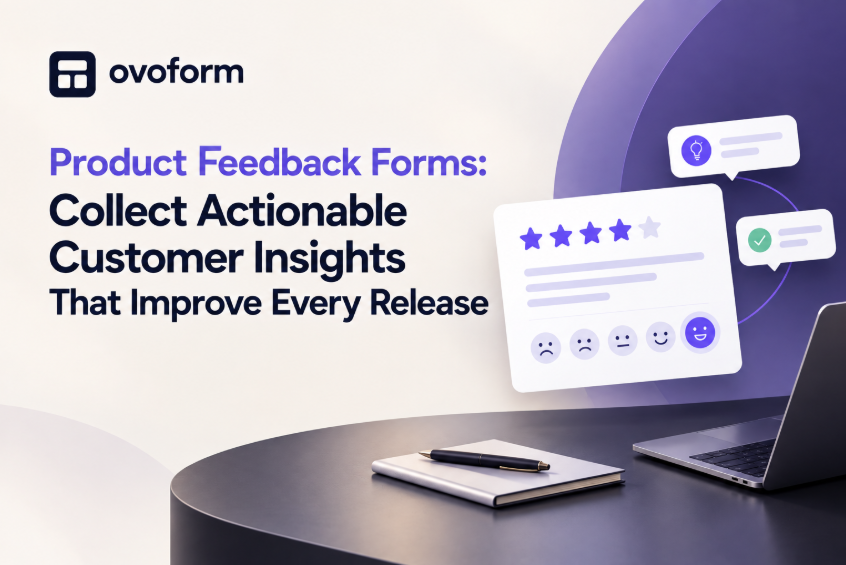
These are used before, during, and after product development to understand what features matter most, what pain points exist, and how users experience a product in practice. Figma, for example, regularly surveys designers about workflow pain points, which directly informs the development roadmap. Product feedback surveys are also essential for validating new ideas before committing engineering resources.
These surveys assess whether your target market knows who you are and what they think of you. They are particularly valuable when entering a new market, repositioning a brand, or measuring the impact of an advertising campaign. A brand like Oatly runs perception surveys to understand whether their sustainability messaging is landing the way they intend it to with different demographic groups.
These ask your customers or target audience about their experience with competing products and services. The goal is to understand what alternatives they consider, what they value about those alternatives, and where competitors fall short. This kind of research gives you genuine differentiation material rather than assumptions.
Segmentation surveys help you understand how different groups within your customer base think and behave differently. Rather than treating all customers as one homogenous group, this research identifies distinct personas with different needs, price sensitivities, and motivations. HubSpot uses segmentation data to personalise their email marketing and onboarding flows by industry and company size, which has measurably improved conversion rates.
The method you choose affects who responds, how they respond, and how much you can trust the results. These are the most commonly used approaches:
Online surveys: fast, affordable, and scalable. Ideal for reaching large audiences and gathering quantitative data. Best sent via email, embedded on a website, or triggered in-product.
In-person interviews: slower but rich. One-on-one conversations produce qualitative depth that surveys alone cannot replicate. Use these to explore complex topics or test early-stage concepts.
Phone surveys: higher completion rates than email for B2B audiences, but time-intensive. Often used in professional services research where access to decision-makers is limited.
Focus groups: structured conversations with small groups. Useful for testing creative concepts, brand messaging, or new product ideas, where group dynamics can surface reactions you would not get in a solo survey.
Panel research: accessing pre-recruited respondent panels to survey specific demographics or professional groups. Faster for reaching niche audiences but typically more expensive.
For most marketing teams, online surveys are the default because they balance speed, cost, and scale. The key is pairing them with occasional qualitative methods to make sure you understand the stories behind the numbers.
The quality of your data depends almost entirely on the quality of your questions. Bad questions produce misleading data, which can be worse than no data at all. Here are the principles that experienced researchers follow:
Avoid jargon, double-barrelled questions (those that ask about two things at once), and anything that requires interpretation. "How would you rate the quality and speed of our service?" asks two separate things. Split it into two questions.
Rating scales (1 to 5 or 1 to 10): best for measuring satisfaction, effort, or likelihood
Multiple choice: ideal for categorical questions with a finite set of answers
Ranking questions: useful for understanding priorities across a list of features or benefits
Open-text questions: essential for capturing nuance, emotion, and unexpected insights
Matrix questions: efficient for comparing multiple attributes using the same scale
Start with broader, easier questions and move toward more specific or sensitive ones. Demographic questions almost always work better at the end, once respondents are already engaged.
Completion rates drop sharply once a survey passes the five-minute mark. If you have twenty questions worth asking, run two separate shorter surveys rather than one long one. A focused five-question survey completed by 300 people is far more valuable than a fifteen-question survey with 60 responses and high dropout halfway through.
Define the decision you need to make. Before you write a single question, be clear about what business decision this research will inform. "We want to understand customer satisfaction" is too vague. "We want to know whether price is the primary reason customers are not upgrading to our premium plan" is actionable.
Identify your audience. Decide exactly who needs to answer this survey. Is it current customers only? Lapsed customers? Prospects at a specific stage of the funnel? The more precise your audience definition, the more relevant your results.
Choose your survey type and method. Match the survey type to your research objective and the method to your audience. Post-purchase? Use a CSAT sent via email. Brand awareness? Consider a panel survey to reach people outside your existing customer base.
Write and test your questions. Draft your questions, then review them against the principles above. Always run a pilot with five to ten people before sending the survey broadly. You will almost always find at least one question that confuses people.
Choose your form template and launch. Use a ready-built feedback survey form template to speed up the setup process. A good template gives you a proven structure you can customise rather than starting from scratch.
Analyse results and identify the key findings. Look for patterns in the data, not just individual responses. What do the numbers tell you? What do the open-text responses confirm or complicate? Aim for one clear, primary insight rather than ten vague observations.
Share findings and take action. Research that sits in a spreadsheet has no value. Share the key findings with the relevant stakeholders, attach a recommendation, and track whether the change you make based on the research actually moves the needle.
Spotify runs in-app surveys asking users how they discover new music and which features they use most. This data directly shapes decisions about algorithm development, playlist curation, and the discovery tools they prioritise in product updates.
Slack uses NPS surveys segmented by company size and industry. When Detractor responses from mid-market teams consistently mentioned onboarding complexity as a friction point, Slack built a dedicated onboarding programme for new workspace admins. The NPS score for that segment improved measurably over the following two quarters.
Before raising membership fees, a UK-based gym chain surveyed 1,200 existing members using a price-sensitivity survey based on the Van Westendorp model. Results showed that most members would accept a price increase of up to 12% if it included two specific new features: extended opening hours and a towel service. The business launched the increase with those two additions and saw churn fall below their projections.
Before launching your next market research survey, keep these best practices in mind:
Define a clear business objective before writing questions
Match the survey type to the decision you need to make
Keep surveys concise and focused
Use a mix of quantitative and qualitative questions
Test your survey before launching it broadly
Analyze patterns rather than individual responses
Start with survey templates to save time and improve consistency
The quality of your survey design directly impacts the quality of your customer insights and the decisions that follow.
Businesses that truly benefit from market research surveys focus on connecting research to decision-making, regardless of budget size. They define their key questions upfront, keep surveys short and targeted, distribute them to the right audience, and act on the insights gained.
Key principles for effective surveys include:
1. Begin with the decision you need to make.
2. Align your survey type with your research objective.
3. Write clear and specific questions, and pilot test them.
4. Combine quantitative data with open-text responses for deeper insights.
5. Use templates to save time and avoid mistakes.
6. Share results with stakeholders and assess the impact of decisions made.
Ready to Launch Your Next Market Research Survey?
Quickly gather valuable customer insights with Ovoform’s ready-to-use survey templates. Create customer satisfaction surveys, product feedback forms, and market research questionnaires without starting from scratch.
Check out our Feedback & Surveys template library for customizable options that help you collect better data and make informed business decisions.
Create surveys, FAQs, and feedback forms in minutes with Ovoform — no code required.
Get started freeStart building with Ovoform today — free forever, no credit card required.
Get Started For Free