Surveys

Learn which post-purchase survey questions to ask, when to send them, and how to collect meaningful feedback from e-commerce customers. Explore practical examples, Shopify survey tips, and ways to use customer insights to improve the shopping experience.
Nikhil Dogra
October 22, 2026
An online store can tell you how many people visited, which products they viewed, and how many completed a purchase. But it cannot always explain why someone chose your store over another, what nearly stopped them from buying, or whether the experience matched their expectations.
Imagine a skincare brand spending heavily on social media ads. Its analytics show a steady flow of orders, but the owner cannot tell whether customers came from Instagram, recommendations, product reviews, or a creator's video. Meanwhile, a few customers complain about confusing product descriptions, yet the store has no clear picture of how widespread the problem is.
A short post-purchase survey can help answer these questions.
The key is to ask the right questions at the right moment. A question about why someone bought belongs close to checkout, while feedback about product quality makes more sense after delivery. Asking everything at once can overwhelm customers and produce answers that are difficult to use.
This guide explains which post-purchase survey questions to ask, how to choose the best timing, and how e-commerce businesses can turn customer feedback into practical improvements.
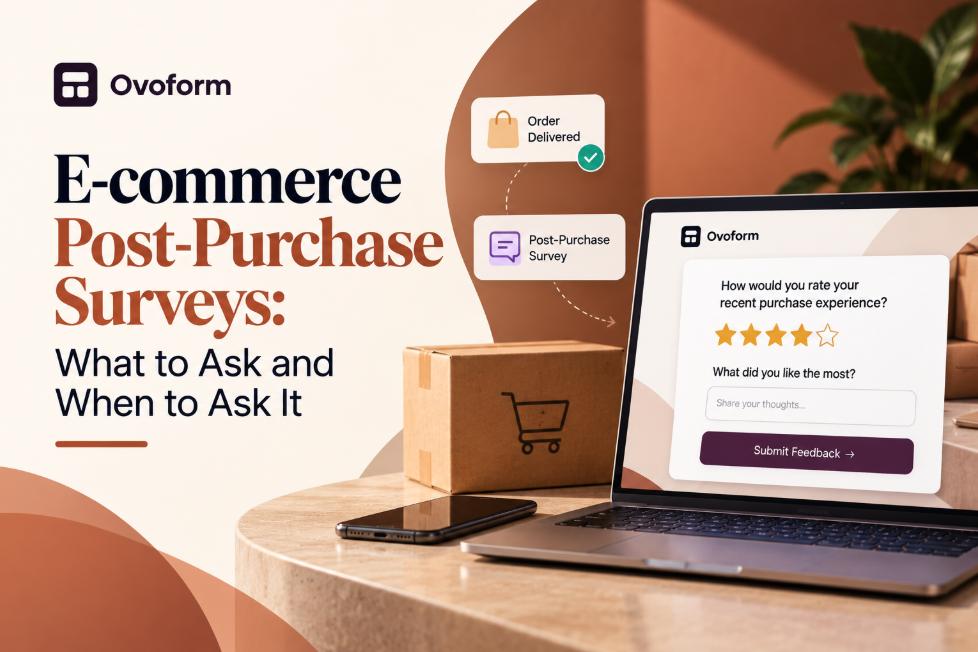
A post-purchase survey is a short questionnaire that asks customers about their buying decision or experience after they place an order.
It can appear on an order confirmation page, arrive through email or SMS, or be shared after delivery. Some surveys focus on marketing attribution, while others measure satisfaction, product quality, delivery, or the checkout experience.
For example, a store might ask, “How did you first hear about us?” immediately after checkout. A few days after delivery, it might ask whether the product matched its description.
These are both post-purchase surveys, but they serve different purposes.
A useful e-commerce customer survey begins with a clear objective. Before writing questions, decide what you need to learn and what you would change based on the answers. That simple step keeps the survey focused and prevents it from becoming a collection of questions nobody acts on.
Purchase analytics show what happened. Customer feedback helps explain why it happened.
A survey can reveal that customers chose your product because of its ingredients, trusted a particular review, or found your return policy reassuring. These insights can help you improve product descriptions, advertising messages, and checkout content.
Post-purchase surveys can also uncover friction that customers tolerated rather than reported. Someone may have completed an order despite unclear shipping costs or difficulty finding a size guide. Without asking, you might never discover the problem.
There are several practical benefits:
Better marketing decisions: Compare what customers remember about discovering your brand with the channels shown in analytics.
More useful product pages: Learn which product details customers value and which questions remain unanswered.
Fewer avoidable complaints: Identify recurring concerns about packaging, sizing, delivery, or product expectations.
Improved customer experience: Give shoppers a straightforward way to share feedback.
Stronger retention: Address recurring problems that may discourage customers from ordering again.
Survey responses are not perfect measurements of customer behavior. People may forget where they discovered a brand or give answers influenced by their most recent experience. Use feedback alongside sales, traffic, returns, and support data rather than treating it as the complete picture.
The best post-purchase survey questions are specific, easy to answer, and connected to a decision. You do not need to ask all 12 in one survey. Choose the questions that fit your current goal.
Purpose: Understand customer acquisition.
Suggested options: Search engine, social media, influencer or creator, friend or family, online review, blog or article, advertisement, or other.
This question can reveal discovery sources that tracking tools do not fully capture. Compare the answers with your analytics to identify useful patterns.
Purpose: Identify purchase motivations.
Suggested options: Price, product quality, reviews, product features, delivery options, return policy, brand reputation, or recommendation.
Use the results to understand which benefits deserve more attention on your product pages and in marketing campaigns.
Purpose: Find purchase barriers.
An optional text field works well here. Customers might mention shipping costs, uncertainty about sizing, limited payment options, or concerns about delivery time.
If the same issue appears repeatedly, investigate whether your checkout or product information needs improvement.
Purpose: Evaluate the checkout experience.
Use a consistent rating scale, such as 1 to 5, with clearly labelled endpoints. If someone gives a low score, show a follow-up asking what made checkout difficult.
Purpose: Improve product descriptions.
This question can uncover missing details about ingredients, dimensions, compatibility, care instructions, or sizing. Add a short optional follow-up asking what information was missing.
Purpose: Measure expectation alignment.
Ask this after the customer has received and had an opportunity to inspect the product. Responses can highlight inaccurate descriptions, unclear photographs, or expectations that need better explanation.
Purpose: Understand fulfilment quality.
Ask after delivery, when the customer can assess delivery speed, packaging, and the condition of the order. If delivery is handled by a third party, use the feedback to identify patterns before deciding what action is appropriate.
Purpose: Find communication gaps.
This is useful for stores that receive questions about shipping updates, order confirmation emails, returns, or product instructions.
Purpose: Establish a satisfaction baseline.
A simple customer satisfaction survey question gives you a starting point for tracking changes over time. Keep the wording and rating scale consistent if you want to compare results across periods.
Purpose: Collect open-ended suggestions.
Keep this question optional. It can reveal problems you did not anticipate, but reviewing free-text responses takes time. Group similar comments into themes rather than treating every response as a separate issue.
Purpose: Understand repeat-purchase intent.
This measures what customers say they intend to do, not whether they will definitely return. Compare responses with actual repeat-purchase behavior when enough time has passed.
Purpose: Give customers room to share unexpected feedback.
Place this question at the end, and make it optional. It is particularly useful when your survey has a narrow main objective but you still want to capture additional comments.
Post-purchase survey timing should depend on what you are asking. Sending the right question at the wrong moment can lead to guesses rather than useful feedback.
Timing | Best questions to ask |
|---|---|
Immediately after checkout | How did you hear about us? What made you choose us? |
On the order confirmation page | Was checkout easy? Was anything unclear? |
After delivery | Was the order delivered on time? Was the packaging in good condition? |
After product use | Did the product meet expectations? What could be improved? |
After a support interaction | Was your issue resolved? How easy was it to get help? |
Before a likely repeat purchase | What would encourage you to order again? |
For many stores, a simple approach is to use two separate surveys. Ask one or two questions on the confirmation page about the purchase decision, then send a short follow-up after delivery.
For products that require time to evaluate, such as skincare, electronics, or home equipment, wait until customers have had a reasonable opportunity to use them. The right delay depends on the product and the feedback you need.
Avoid sending repeated surveys after every interaction. Consider how recently the customer responded and whether another survey would provide genuinely different information.
A Shopify post-purchase survey does not need to be complicated. Start with the customer journey and choose where a question will be most useful.
Step 1: Choose your objective. Decide whether you want to understand acquisition sources, improve checkout, evaluate delivery, or measure product satisfaction. Start with one main objective.
Step 2: Select the right placement. An order confirmation page is useful for questions about the purchase decision. Email is often more suitable when customers need time to receive or use the product.
Step 3: Keep the survey short. Start with one to four questions for a quick survey. Add more only when each question serves a clear purpose.
Step 4: Check your integration options. Depending on your setup, you may use a survey app, an embedded form, or a link in an email. Verify that the chosen solution works with your Shopify theme, checkout setup, and existing marketing tools. Do not assume every form builder can access every checkout event or order field.
Step 5: Organize the responses. Where supported and appropriate, connect responses to order details or customer segments. Follow applicable privacy requirements and collect only the information you need.
Step 6: Review and improve. Look for recurring patterns, make one meaningful change, and check whether the problem becomes less common.
If you want to compare approaches before choosing a platform, explore these online form templates for ideas on question structure and survey design. For a broader understanding of available form-building capabilities, review the form builder features and confirm that the specific integrations you need are supported.
Getting more survey responses is useful only if those responses are meaningful. These practices help make an e-commerce customer feedback process more effective.
Every question should have a reason to exist. If you cannot explain what decision a question will inform, remove it or save it for another survey.
Three to six questions can be a reasonable starting point for many post-purchase surveys, but the ideal length depends on placement, complexity, and customer motivation.
Multiple-choice questions and rating scales reduce the effort required to respond. Use an optional text field when you need context that predefined answers cannot capture.
Avoid asking two things at once. “Was delivery fast and packaging good?” is difficult to interpret because a customer may be satisfied with one and unhappy with the other.
Show follow-up questions only when they are relevant. For example, a low checkout rating could reveal a question about payment options, while a delivery complaint could prompt a question about timing.
This keeps the main survey short without losing useful detail. Learn more about conditional logic in forms and how it can guide respondents through relevant questions.
Customers may open a survey on the same phone they used to shop. Use readable text, clear answer options, accessible controls, and a layout that works on smaller screens. Test the complete experience before sharing it.
A small incentive may encourage participation, especially for a longer survey. However, it can also influence who responds. If you offer a reward, make it clear that honest feedback is welcome regardless of whether it is positive or negative.
Do not make customers feel that they must give a favourable rating to receive a benefit.
Collecting answers is only the beginning. Review the results regularly, assign responsibility for recurring issues, and tell relevant teams what customers are reporting.
For example, if shoppers repeatedly mention unclear delivery costs, update the checkout information and monitor support enquiries or checkout performance afterward.
A successful post-purchase survey should lead to better decisions, not simply a large spreadsheet of responses.
Track a small set of measures:
Response rate: The share of invited customers who complete the survey. Define the eligible audience and completion criteria consistently.
Acquisition-source patterns: Compare self-reported discovery sources with your existing marketing analytics.
Recurring feedback themes: Monitor issues such as sizing, shipping costs, packaging, or missing product details.
Customer satisfaction: Track the same question and scale over time, while accounting for changes in the customer mix.
Business outcomes: Where relevant, monitor return rates, support contacts, checkout completion, and repeat purchases after making changes.
Your form analytics can be useful when evaluating survey completion and respondent behaviour, depending on the features available in your setup. Combine survey results with your store's own business metrics for a more complete view.
Avoid assuming that an improvement happened because of a survey alone. If you change a product page, shipping policy, and advertising campaign at the same time, it may be difficult to identify which change mattered. When practical, make focused changes and compare results over a suitable period.
Consider a clothing store that receives repeated comments about inconsistent sizing. Rather than adding another general satisfaction question, the team groups feedback by product and checks return reasons.
It discovers that customers frequently misunderstand the fit of one collection. The team updates the size guide, adds clearer fit descriptions, and checks subsequent returns and support messages.
This is the real value of a post-purchase survey: it helps connect what customers say with a specific improvement.
You can use a similar process for marketing. If customers frequently mention a recommendation from a friend, compare those responses with referral traffic and campaign data. If shoppers say they nearly abandoned checkout because delivery costs were unclear, review how and when those costs appear.
For customer satisfaction tracking, a CSAT survey template can help you plan a consistent rating question. If your goal is broader feedback across the customer journey, explore the feedback and surveys template category for additional starting points.
Ovoform is one option for creating surveys with a visual form builder, conditional questions, and sharing options. Choose a solution based on the survey workflow, integrations, reporting, and privacy requirements your store actually needs.
A useful post-purchase survey is not the one with the most questions. It is the one that helps you understand a customer's decision, experience, or concern—and gives your team a clear next step.
Start by choosing one objective. Ask a small number of relevant questions at the right moment, make responding easy, and review the results alongside your store's existing data.
Then act on what you learn. Improve a product description, clarify delivery information, fix a checkout problem, or investigate a recurring complaint. Over time, this process can make customer feedback a practical part of running a better e-commerce business.
Create surveys, FAQs, and feedback forms in minutes with Ovoform — no code required.
Get started freeStart building with Ovoform today — free forever, no credit card required.
Get Started For Free