Form Builders

A well-designed quiz funnel helps businesses qualify leads, personalize customer journeys, and improve conversion rates. This guide explains how quiz funnels work, key features to look for, common mistakes to avoid, and how to choose the right platform for scalable lead generation.
Nikhil Dogra
September 15, 2026
Driving traffic to your website is only the first step. The bigger challenge is turning those visitors into leads you can understand, segment, and follow up with.
A quiz funnel turns a standard website interaction into a guided experience. Instead of asking every visitor to fill out the same form, you ask questions that help you understand what they need and then use their answers to determine the next step.
For marketers and e-commerce brands, this can make lead generation more useful because the information collected through the quiz can help separate high-intent prospects from casual visitors.
In this guide, you'll learn how to build a quiz funnel, what questions to ask, where to capture lead information, how to use conditional logic and automation, and which quiz funnel builders are worth considering in 2026.
A quiz funnel is a marketing funnel that uses an interactive quiz to collect information from visitors and guide them toward a relevant result, recommendation, or next action.
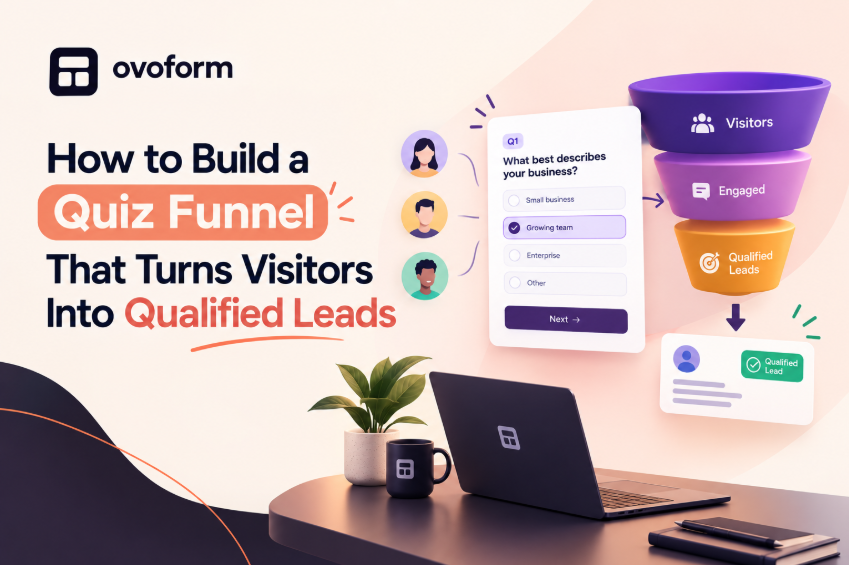
A typical quiz funnel looks like this:
Traffic → Quiz → Questions → Segmentation → Personalized Result → Lead Capture → Follow-Up
Quiz funnels are commonly used for:
Lead generation
Product recommendations
Lead qualification
Audience segmentation
Customer research
Assessments
Consultations
Personalized content recommendations
The questions are not simply there to collect data. They should help the visitor move toward something useful, such as a product recommendation, assessment result, solution, or next step.
For example, an online skincare store could ask about skin concerns, skin type, and product preferences before recommending a suitable routine. A SaaS company could ask about team size, current tools, and business needs before suggesting the most relevant solution.
Traditional forms can work well when visitors already know what they want. But when customers have different needs, preferences, or levels of buying intent, a personalized experience can be more useful.
A well-designed quiz funnel can help businesses:
Qualify Leads
Questions can reveal information about a prospect's needs, budget, company size, goals, or challenges before the lead reaches a sales team.
Segment Audiences
Different answers can place visitors into different audience segments. These segments can then receive more relevant emails, recommendations, or offers.
Personalize Recommendations
A product recommendation quiz can match visitors with products based on their answers rather than showing the same products to everyone.
Increase Engagement
Interactive questions require visitors to participate instead of simply filling out a static form.
Improve Follow-Up
Quiz responses provide additional context that can be used to personalize sales and marketing follow-ups.
The key is to collect information that has a clear purpose. A longer quiz is not automatically better if the additional questions don't improve qualification or personalization.
Building an effective quiz funnel starts with the outcome, not the questions. Before creating the quiz, decide what you want visitors to do after completing it.
1. Define Your Quiz Funnel Goal
Start with one primary objective.
Your quiz might be designed to:
Generate leads
Recommend products
Qualify sales prospects
Segment email subscribers
Book consultations
Assess customer needs
Recommend a service or solution
For example, an e-commerce company might create a product recommendation quiz, while a B2B company could create a lead qualification quiz.
Having one clear goal makes it easier to decide which questions belong in the funnel.
2. Identify Your Target Audience
Next, determine who will take the quiz and what information would actually help you serve them better.
Consider questions such as:
Who will take the quiz?
What are they trying to solve?
What information would help you understand their needs?
What result would be genuinely useful to them?
Avoid trying to create one quiz for everyone. A focused quiz usually makes it easier to write relevant questions and meaningful results.
3. Choose the Right Quiz Type
The quiz format should match your objective.
Quiz Type | Best For |
Product recommendation quiz | E-commerce |
Lead qualification quiz | B2B and SaaS |
Personality quiz | Audience engagement and segmentation |
Assessment quiz | Consultants and professional services |
Knowledge quiz | Education and engagement |
Preference quiz | Product and content recommendations |
For example, an e-commerce brand could create a product recommendation quiz, while a marketing agency could use an assessment to identify businesses that need its services.
4. Create Questions That Move the Funnel Forward
Every question should have a reason to exist.
Good quiz questions help you:
Understand the visitor
Determine which result they should receive
Qualify their needs
Improve the next step
Avoid questions that are interesting but don't affect the result or follow-up.
Keep the language simple and make the answers easy to understand. There is no universal ideal number of questions; the right length depends on the complexity of the decision you're helping the visitor make.
5. Add Conditional Logic
Conditional logic allows the quiz to respond to a visitor's answers.
For example:
Question: What type of business do you run?
E-commerce → Ask about product category
SaaS → Ask about team size
Agency → Ask about client volume
Instead of showing every participant the same sequence, the quiz can show questions that are relevant to their previous answers.
This keeps the experience focused and prevents visitors from answering unnecessary questions.
6. Create Useful Results
The result is one of the most important parts of the funnel.
Don't simply display:
"Your result is: Type B."
Explain what the result means and what the visitor should do next.
A strong result page can include:
A summary of their answers
A recommendation
Relevant products or services
Helpful resources
A clear next step
A call to action
For an e-commerce quiz, the result could recommend three products. For a SaaS quiz, it could suggest the most appropriate plan or workflow.
7. Decide When to Capture Lead Information
You don't always need to ask for an email address at the beginning.
Depending on your funnel, you can place lead capture:
Before the quiz
After a few questions
Before showing the result
After showing the result
The right choice depends on how much value the visitor receives before being asked for their information.
If the quiz result is valuable, you might offer to send the result or recommendation by email.
Keep the form focused on information you actually need.
8. Connect the Follow-Up
Once someone completes the quiz, decide what should happen next.
For example:
Quiz completed → Lead captured → Segment created → Email sent → Sales follow-up
A product recommendation quiz might send product-specific emails. A B2B qualification quiz could send qualified leads to a CRM or notify a sales representative.
Integrations and automation tools can help move quiz responses into the systems your team already uses.
9. Test Every Answer Path
Don't test only the first or most obvious path.
Check:
Every answer combination
Conditional logic
Result pages
Lead capture
Email notifications
CRM or other integrations
Mobile experience
Thank-you pages
Tracking events
A single incorrect rule can send visitors to the wrong question or result, so testing the complete journey is essential.
10. Launch, Measure, and Improve
Once the quiz is live, monitor how visitors move through it.
Useful metrics include:
Quiz starts
Completion rate
Drop-off by question
Lead capture rate
Result distribution
Qualified lead rate
Conversion rate
Revenue or sales generated
If many visitors leave at one question, review its wording, length, or relevance.
If the quiz gets completed but produces few qualified leads, revisit the questions and qualification criteria.
Optimization should be based on where the funnel is losing people or producing poor-quality leads.
Quiz funnels can be adapted to many industries. The most effective examples usually connect the visitor's answers directly to a useful recommendation or next step.
E-commerce Product Finder
A clothing store could ask about style, occasion, fit, color preferences, and budget.
The final result could recommend a small selection of products instead of making the shopper browse the entire catalog.
SaaS Lead Qualification Quiz
A SaaS company could ask about:
Team size
Current tools
Main challenge
Number of users
Desired features
Implementation timeline
The result could direct prospects toward a free trial, demo, resource, or sales conversation.
Agency Assessment
An SEO agency could create a website SEO assessment that asks about organic traffic, technical issues, content, backlinks, and business goals.
The final result could highlight potential areas for improvement and offer a consultation.
Personality Quiz for Business
A brand can use a personality quiz to group visitors into profiles based on preferences or behaviors.
For example, a travel company could identify whether someone is a Relaxed Traveler, Adventure Seeker, or Culture Explorer, then recommend relevant destinations or packages.
Quiz Funnel vs. Traditional Lead Form
A traditional lead form is often the better choice when you only need a small amount of information.
A quiz funnel makes more sense when the answers can influence qualification, recommendations, segmentation, or the next step.
Factor | Traditional Lead Form | Quiz Funnel |
Data collection | Basic | More contextual |
User experience | Direct | Interactive |
Qualification | Limited | Stronger potential |
Personalization | Usually limited | Built into the experience |
Best for | Simple inquiries and signups | Recommendations, qualification, segmentation |
Setup | Usually simpler | Requires more planning |
The goal isn't to replace every lead form with a quiz. Use a quiz when the interaction itself adds value.
When choosing quiz funnel software, look for capabilities that support the complete visitor journey.
Conditional Logic
The builder should allow questions and outcomes to change based on previous answers.
Lead Capture
Look for flexible lead forms and the ability to control when visitor information is requested.
Automation and Integrations
Connections with email platforms, CRMs, spreadsheets, webhooks, and other tools can reduce manual work after submission.
Analytics
You should be able to understand starts, completions, drop-offs, and conversions.
Customization
The quiz should fit your brand rather than looking like an unrelated third-party form.
AI Assistance
AI can speed up question creation, help structure quizzes, and reduce the time required to build an initial version.
Mobile Experience
Many visitors will complete quizzes on mobile devices, so check the experience on smaller screens before launching.
Quiz funnel platforms differ in automation, integrations, customization, and analytics. The best choice depends on your business goals, team size, budget, and existing software. The comparison below highlights each platform's strengths and trade-offs to help you choose the right solution.
Tool | Best For | AI | Automation | Zapier | No-Code | Starting Price | Value for Money |
Ovoform | Interactive lead generation | Yes | Yes | Yes | Yes | Free •30/days Pro Trail Free . •$19/month | Excellent |
Interact | Marketing quizzes | Limited | Yes | Yes | Yes | $39/month | Very Good |
Multi-step funnels | Yes | Yes | Yes | Yes | Free, Paid plans from $29/month | Very Good | |
Typeform | Conversational quizzes | Yes | Yes | Yes | Yes | Free, Paid plans from $29/month | Good |
Outgrow | Product recommendations | Yes | Yes | Yes | Yes | From $22/month (billed annually) | Very Good |
Jotform | General-purpose forms | Limited | Yes | Yes | Yes | Free, Paid plans from $39/month | Very Good |
ScoreApp | Lead qualification | Limited | Yes | Yes | Yes | Free plan available, paid plans on request | Good |
Ovoform
Ovoform is an AI-powered form and survey builder that can also be used to create interactive quizzes and lead-generation experiences.
You can start with an AI-generated form or quiz and then customize questions, logic, design, and workflows without coding.
Ovoform supports:
AI-assisted form and quiz creation
Conditional logic
Workflow automation
Analytics
Integrations and webhooks
Custom branding
Templates
Lead-generation forms and quizzes
It is a good fit for marketers, SaaS companies, agencies, small businesses, and teams that want to create interactive experiences without building them from scratch.
New users can currently try Pro free for 30 days, with unlimited responses and no credit card required.
Interact
Interact focuses heavily on marketing quizzes, particularly quizzes designed to generate leads, segment audiences, and connect responses with marketing workflows.
It can be useful for businesses where quizzes are primarily part of an email marketing or audience segmentation strategy.
involve.me is built around interactive experiences including quizzes, forms, surveys, calculators, and assessments.
It is particularly useful when a business wants to combine data collection with more interactive content and lead qualification.
Typeform is known for conversational forms and visually focused experiences.
It can work well for brands that prioritize the presentation and flow of customer-facing forms and quizzes.
Outgrow focuses on interactive content such as quizzes, calculators, assessments, and recommendation tools.
It can be useful when a business wants to turn an interactive experience into a lead-generation or recommendation funnel.
Jotform is a broad form-building platform with extensive business functionality, including workflows, payments, integrations, and templates.
It is a strong option for organizations that need quizzes alongside many other types of forms.
ScoreApp focuses on assessments and score-based lead qualification.
It can be a good fit for consultants, coaches, agencies, and businesses that use assessments as part of their lead-generation process.
Even a well-designed quiz funnel can underperform if common implementation mistakes are overlooked. Addressing these issues early helps improve lead quality, user experience, and conversion rates.
Asking for too much information
Long forms can create unnecessary friction. Ask only questions that contribute to the result, qualification, or next step.
Asking for contact details too early
If visitors haven't received any value yet, requesting personal information can make them abandon the quiz.
Creating generic results
A result should tell the visitor something useful and provide a logical next action.
Ignoring mobile users
Buttons, text, answer options, and result pages should all work comfortably on smaller screens.
Not measuring drop-offs
A quiz isn't finished when it goes live. Look at where people leave and use that information to improve the experience.
✅ Define one clear quiz objective
✅ Keep questions concise and relevant
✅ Use conditional logic for personalization
✅ Connect CRM and email integrations
✅ Automate follow-up workflows
✅ Test every answer path
✅ Optimize for mobile devices
✅ Review analytics regularly
✅ Verify security and privacy settings
✅ Update quizzes based on user feedback
A quiz funnel works best when the interaction helps both sides.
Visitors get a more relevant experience, while businesses can collect useful information, identify qualified prospects, and create more targeted follow-up journeys.
The process starts with a clear goal and audience. From there, build questions around that goal, use conditional logic where it improves the experience, create useful results, and connect the completed quiz to the next step.
If you want to create interactive quizzes and lead-generation funnels without coding, Ovoform provides AI-assisted creation, conditional logic, automation, integrations, and analytics in one platform.
Get Pro Free for 30 Days with unlimited responses and full Pro access - no credit card required.
Create surveys, FAQs, and feedback forms in minutes with Ovoform — no code required.
Get started freeStart building with Ovoform today — free forever, no credit card required.
Get Started For Free