Surveys

Turning customer ideas into the right product improvements starts with a structured process. This guide explains how a feature request form can centralize customer suggestions, uncover the problems behind requests, and support better prioritization using frameworks like RICE, value-versus-effort analysis, customer voting, and strategic alignment.
Nikhil Dogra
October 5, 2026
A SaaS founder opens their inbox on a Monday morning and finds 43 new feature requests waiting. One customer wants dark mode. Another wants a Zapier integration. A third needs something so specific to their workflow that it is difficult to tell whether anyone else would use it. Every customer has a reason for asking, and many believe their request should be next.
This is a familiar challenge for growing software companies. Collecting feature requests is relatively easy. Deciding which ideas deserve development time is much harder.
Without a consistent process, requests get scattered across emails, support tickets, sales calls, and chat messages. Teams may prioritize the most recent complaint, the loudest customer, or whichever idea is easiest to build. Meanwhile, valuable suggestions from quieter customers can go unnoticed.
A well-designed feature request form helps organize these ideas from the beginning. Combined with a practical prioritization framework, it gives product teams a clearer way to understand customer problems, compare opportunities, and make roadmap decisions.
This guide explains what to include in a feature request form, how to evaluate competing ideas, and how to build a repeatable process that turns customer requests into useful product improvements.
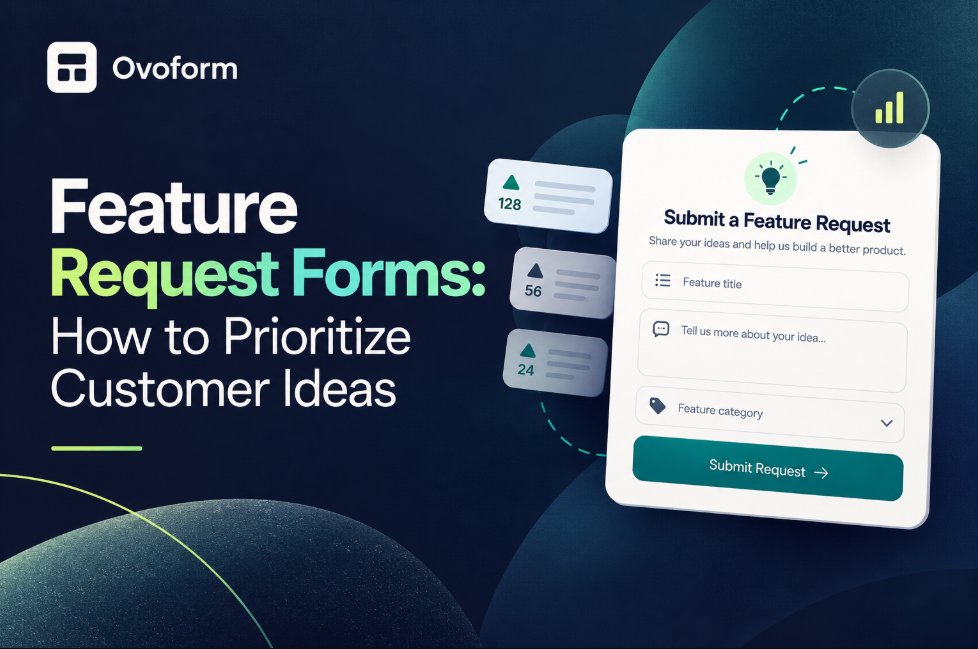
A feature request form is a structured way for customers to suggest new functionality, improvements, or changes to an existing product. Instead of relying on scattered conversations, businesses collect suggestions in one place.
A useful form captures more than the feature someone wants. It also asks about the problem they are trying to solve, their current workaround, and how frequently they encounter the issue.
For example, a customer might request a new reporting dashboard. Asking why they need it could reveal that they simply want to export existing data more easily. That underlying problem may have a simpler solution than building an entirely new dashboard.
The form is only the first step, however. Requests still need to be reviewed, grouped, evaluated, and tracked. An organized submission process makes it easier to identify recurring problems and connect customer feedback to the product roadmap.
Feature request processes often fail because collecting ideas and managing them are treated as separate activities.
Requests may arrive through five different channels, with inconsistent details and no clear owner. Several customers might describe the same problem using different words, making it difficult to recognize a common need. Other requests may sit untouched for months.
Prioritization becomes especially difficult when decisions depend on individual opinions. A direct message from an influential customer can suddenly outrank a request supported by dozens of other users, even when the broader opportunity has not been evaluated.
Common problems include:
Scattered submissions: Ideas are spread across support tickets, emails, calls, and spreadsheets.
Duplicate requests: Similar suggestions are counted separately instead of grouped by the underlying problem.
Unclear priorities: Teams lack consistent criteria for comparing requests.
No ownership: Nobody is responsible for reviewing submissions and communicating decisions.
Missing follow-up: Customers never learn whether their suggestions were considered or implemented.
A structured customer feedback management process helps address these issues by giving every request a consistent path from submission to review and, where appropriate, development.
A good feature request form collects enough context to support a decision without making submission unnecessarily difficult. Start with these essential fields.
1. The problem the customer wants to solve
Ask, “What are you trying to accomplish?” rather than only asking which feature they want. This helps uncover the real need behind the suggestion and leaves room for alternative solutions.
2. The current workaround
Find out how customers handle the problem today. They might use another tool, complete a manual process, maintain a spreadsheet, or avoid the task altogether. The answer helps reveal the inconvenience involved.
3. How frequently the problem occurs
Ask whether the issue happens daily, weekly, monthly, or only occasionally. Frequency can help distinguish recurring friction from a rare edge case.
4. The expected benefit
Invite customers to explain what would improve if the request were addressed. Would it save time, reduce errors, simplify collaboration, or help them complete an important task?
5. Supporting details
Allow optional screenshots, examples, or links when they would help explain the request. Keep attachments optional so they do not become a barrier to submitting a simple idea.
6. Relevant account information
Where appropriate, connect submissions to existing customer records in your CRM. Account type, plan, usage, and renewal context can help the team understand the request's business implications. Avoid asking customers to provide information your system already knows.
Use a form builder that lets you create and adjust these fields easily. Ovoform's AI form builder can help teams get started by generating a form from a natural-language prompt, which they can then review and customize for their workflow.
Once requests are organized, the next challenge is deciding what deserves attention. There is no single framework that works for every company, but the following approaches provide useful starting points.
RICE stands for Reach, Impact, Confidence, and Effort. It helps teams compare ideas using a consistent set of criteria.
The formula is:
RICE score = (Reach × Impact × Confidence) ÷ Effort
Reach estimates how many users will benefit during a defined period. Impact represents the expected benefit to each affected user, using a consistent scale. Confidence reflects how certain the team is about its estimates, and Effort estimates the work required to deliver the improvement.
Consider two hypothetical requests:
Request A: Reach of 500 users, impact of 2, confidence of 80% (0.8), and effort of 5 units.
Request B: Reach of 200 users, impact of 3, confidence of 90% (0.9), and effort of 2 units.
Request A scores 160: (500 × 2 × 0.8) ÷ 5.
Request B scores 270: (200 × 3 × 0.9) ÷ 2.
Although Request A reaches more users, Request B has a higher score because its estimated impact and confidence are stronger relative to the effort required.
These figures are illustrative, not industry benchmarks. Teams should define consistent scoring scales, use comparable time periods, and document assumptions. A RICE score helps structure a discussion; it does not automatically determine what gets built.
A value-versus-effort matrix is a simpler alternative for teams that need a quick way to evaluate ideas.
Estimate the customer value of each request and compare it with the effort required to deliver it. High-value, low-effort improvements are potential quick wins. High-value, high-effort initiatives may deserve strategic planning, while low-value, high-effort requests often need stronger justification.
The matrix works well for small teams that do not yet have enough data to make detailed numerical estimates. It can also help product managers explain why a seemingly useful request is not an immediate priority.
Allowing customers or internal teams to vote on existing requests can reveal recurring needs. A public or shared request board can also reduce duplicates by letting users support an existing idea rather than submitting the same suggestion again.
However, vote counts should not be treated as a complete prioritization system. They may favor the most active users, overlook less vocal customer segments, or reflect temporary interest rather than long-term value.
Use votes as one signal alongside product strategy, customer impact, technical effort, and business goals.
Before committing to a highly ranked request, ask whether it supports the product's direction. A feature may attract votes and appear inexpensive to build but introduce complexity that does not serve the product's intended audience.
Check whether the request solves a meaningful problem, supports strategic goals, and fits the team's capacity. This final review helps prevent a backlog from becoming a collection of disconnected features.
Early-stage SaaS
A small team may review every request manually each week. A simple form asking about the problem, workaround, and expected benefit is often enough. The priority should be learning which problems repeatedly prevent customers from succeeding.
Growth-stage SaaS
As submission volume increases, requests can be grouped by theme and connected to a shared product board. Teams may use RICE scoring for larger opportunities while reviewing small fixes separately. Automated routing can help ensure that product feedback reaches the appropriate owner.
Enterprise-focused SaaS
Requests from important accounts deserve careful attention, particularly when they relate to adoption, contractual commitments, or renewal risks. However, account value should not automatically override broader customer needs. Teams should weigh revenue implications alongside user impact, strategic fit, evidence of demand, and implementation costs.
Product-led growth companies
A searchable request board can help users support existing ideas. The team can then focus its review on recurring themes and new problems instead of processing large numbers of duplicate submissions.
A consistent process improves more than backlog organization. It helps product teams make better decisions and communicate them clearly.
Fewer duplicate requests: Grouping similar submissions reveals the number of customers experiencing the same problem.
Clearer roadmap decisions: Documented criteria help teams explain why one improvement is prioritized over another.
Better customer insights: Requests can expose usability problems, missing integrations, and unmet needs that analytics alone may not explain.
Reduced decision-making bias: Consistent evaluation makes it less likely that the latest complaint will automatically take priority.
Stronger customer relationships: Status updates and follow-ups show customers that their input is being considered.
More focused development: Teams can compare expected benefits against the time and resources needed to deliver improvements.
These benefits depend on actually reviewing and using the information collected. A detailed form will not improve product decisions if submissions simply accumulate without an owner or review schedule.
Treating every request as a commitment. Customers should feel comfortable sharing ideas, but submission does not guarantee development. Explain that requests are evaluated against multiple criteria.
Building the requested feature without understanding the problem. A customer may suggest one solution when a simpler improvement would address the underlying issue more effectively.
Prioritizing by votes alone. Popularity is useful evidence, but it should not replace strategic judgment or an assessment of effort and impact.
Giving enterprise requests automatic priority. High-value accounts can have important needs, but decisions should also consider other customers, product direction, and long-term maintainability.
Collecting too much information. An excessively long form can discourage submissions. Ask only for details that help the team understand or evaluate the request.
Ignoring customers after submission. Even when an idea is declined or delayed, a clear status or explanation can prevent uncertainty and repeated follow-ups.
Start with a focused form that captures the problem, current workaround, and expected benefit. Add optional supporting details and connect submissions to your CRM or product management workflow through form integrations where practical.
Next, establish a regular review cadence. A small team might review requests weekly, while a larger team could combine routine triage with a monthly roadmap review. Assign an owner who can merge duplicates, clarify missing information, and prepare requests for evaluation.
Choose one primary prioritization framework and apply it consistently. Record important assumptions, revisit scores when new evidence arrives, and allow urgent bugs or security issues to follow a separate process when necessary.
Make request statuses visible where appropriate, using clear stages such as submitted, under review, planned, in progress, and released. Not every request needs a public roadmap, but customers should understand what happens after they submit an idea.
Finally, close the loop. When a requested improvement ships, notify the customers who raised the issue if you can identify them and have permission to contact them. Their original problem provides a natural reason to explain what changed and invite further feedback.
To streamline form creation, teams can use an AI form builder to draft and customize request forms. For conversational form creation and management through ChatGPT or Claude, explore Ovoform MCP.
A feature request form is not simply a place to collect ideas. It is the starting point for a repeatable process that turns customer needs into informed product decisions.
The strongest systems ask about the problem behind each request, organize similar submissions, and evaluate opportunities using consistent criteria. Frameworks such as RICE and value-versus-effort analysis can make trade-offs clearer, but they work best when combined with customer evidence, strategic judgment, and regular communication.
Start with a manageable form, review requests consistently, and explain what happens next. Over time, this approach can help your team identify meaningful improvements, make more defensible roadmap decisions, and show customers that their feedback matters.
Create surveys, FAQs, and feedback forms in minutes with Ovoform — no code required.
Get started freeStart building with Ovoform today — free forever, no credit card required.
Get Started For Free