Surveys

Learn how to create donation forms that make online giving easier and more effective. Discover 12 real donation form examples and practical best practices for reducing friction, building trust, encouraging recurring donations, optimising mobile experiences, and improving donor engagement with secure, user-friendly forms.
Nikhil Dogra
September 19, 2026
It was a cold Thursday evening in Manchester.
Emma had just finished dinner when a post from her local food bank appeared on social media. The charity needed emergency donations. Rising living costs meant more families were asking for help than ever before, and the shelves were running low.
Without thinking twice, she clicked "Donate Now."
She wanted to help.
The donation form opened.
First came the account registration.
Then a long list of personal details.
Then another page asking questions that didn't seem relevant.
By the time she reached the payment section, nearly three minutes had passed.
Her phone buzzed with a work notification.
She closed the tab.
The charity never received her donation.
The next day, Emma donated the same amount to another organisation.
Not because their cause mattered more.
Because their donation form made giving feel effortless.
Within 45 seconds, she chose an amount, selected Gift Aid, paid securely, and received a heartfelt thank-you email before she had even put her phone down.
That single experience highlights something many charities overlook.
People rarely stop giving because they stop caring.
They stop because the donation experience creates unnecessary friction.
Every extra field, confusing question, slow-loading page, or complicated payment process gives potential supporters another opportunity to leave.
For charities, nonprofits, schools, churches, community groups and fundraising campaigns across the UK, your donation form isn't just a payment page—it's often the deciding factor between someone wanting to help and actually completing their gift.
The good news?
Creating a high-converting donation form doesn't require a huge budget or a team of developers.
In this guide, you'll discover what makes a great donation form, explore proven examples from different fundraising campaigns, learn the best practices used by successful charities, and see how modern form builders like Ovoform can help you create donation experiences that encourage more people to give.
Online giving has become the preferred way for many supporters to donate. Whether someone discovers your charity through social media, an email campaign, or a fundraising event, they're likely to complete their donation on a laptop or mobile phone.
Your donation form is where that generosity turns into action.
A well-designed form can:
Increase completed donations
Reduce abandoned transactions
Encourage recurring giving
Build donor trust
Simplify Gift Aid collection
Improve donor data quality
Reduce administration for your team
In contrast, a poor donation experience can discourage even the most willing supporters.
A donation form is an online form that enables supporters to contribute money securely to a charity, nonprofit, community organisation, school, or fundraising campaign.
Beyond collecting payments, a modern donation form can also:
Capture donor details
Offer one-off or monthly giving
Collect Gift Aid declarations
Allow supporters to dedicate donations
Send automatic receipts
Integrate with CRM and fundraising tools
1. General Charity Donation Form
Ideal for organisations accepting everyday donations.
Include:
Donation amount
One-off or monthly giving
Gift Aid option
Secure payment
Thank-you message
2. Emergency Appeal Form
Perfect for disaster relief or urgent fundraising.
Keep the form short and highlight the urgency of the campaign.
3. Local Community Fundraiser
Suitable for food banks, shelters, and community projects.
Show supporters exactly how their contribution helps local people.
4. Children's Charity Donation Form
Use emotional storytelling and explain how donations support education, healthcare, or family services.
5. Animal Rescue Donation Form
Allow donors to sponsor animals, contribute towards medical care, or support shelter improvements.
6. Church Giving Form
Offer options for:
Weekly giving
Tithes
Building funds
Special events
7. School Fundraising Form
Ideal for PTAs, scholarships, classroom projects, and educational initiatives.
8. Memorial Donation Form
Allow supporters to donate in memory of a loved one while leaving a personal tribute.
9. Event Fundraising Form
Perfect for charity walks, marathons, gala dinners, and fundraising events.
10. Medical Research Appeal
Explain how each donation contributes to research, treatments, or patient care.
11. Environmental Campaign Donation Form
Support tree planting, wildlife conservation, clean water initiatives, or climate action projects.
12. Corporate Giving Form
Designed for businesses making larger donations or matching employee contributions.
1. Tell a Story Before Asking for Money
People donate because they connect with people, not processes.
Instead of saying:
"Support our charity."
Say:
"Your £20 could provide emergency meals for a family this weekend."
A compelling story creates emotional engagement before the donation request appears.
2. Keep the Form Short
Every additional field creates friction.
Only ask for information that genuinely matters.
Most charities only need:
Name
Donation amount
Payment details
Gift Aid declaration (where applicable)
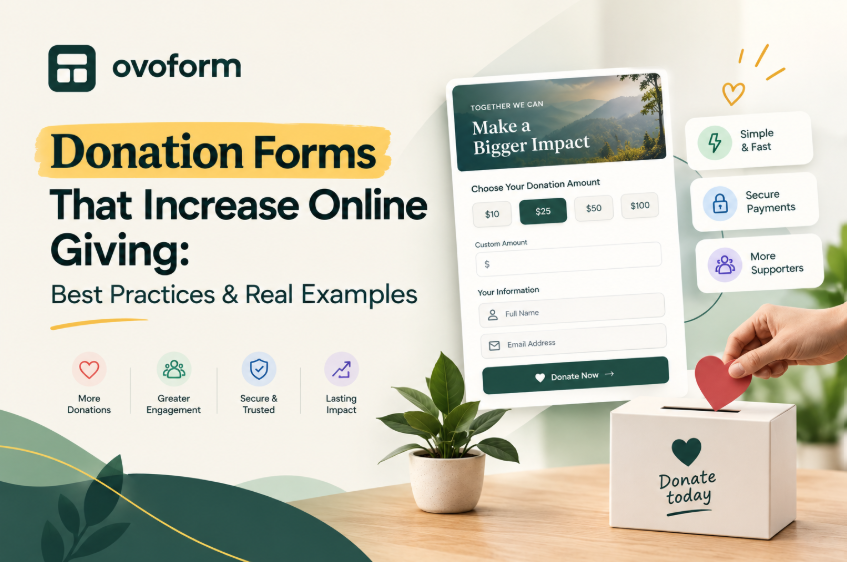
3. Offer Suggested Donation Amounts
Many supporters appreciate guidance.
Instead of leaving a blank amount field, offer options such as:
£10
£25
£50
£100
Custom amount
Adding a short explanation of each amount's impact can encourage larger donations.
4. Explain Where the Money Goes
Transparency builds trust.
For example:
£15 provides school supplies.
£30 feeds a family for a week.
£100 funds emergency shelter equipment.
When donors understand the real-world impact of their gift, they're more likely to complete the donation.
5. Optimise for Mobile Devices
Many donations happen on mobile phones.
Your form should have:
Large buttons
Simple layouts
Fast loading times
Mobile-friendly payment options
6. Build Trust with Security Signals
Supporters are sharing payment information, so confidence is essential.
Include:
SSL encryption
Secure payment logos
Privacy statement
Charity registration details
7. Make Monthly Giving Easy
Recurring donors provide long-term stability.
Include a simple toggle between:
One-off donation
Monthly donation
Without making recurring giving feel forced.
8. Personalise the Thank-You Experience
Don't stop after payment.
Send:
Instant confirmation
Donation receipt
Thank-you email
Updates showing the impact of donations
Strong stewardship encourages future giving.
9. Use Conditional Logic
Different supporters may need different questions.
For example:
Corporate donors may require company details, while individual supporters won't.
Conditional logic keeps forms clean and relevant.
10. Test and Improve Regularly
Small changes can significantly affect donation rates.
Experiment with:
Button text
Suggested amounts
Headlines
Images
Form length
Call-to-action wording
Continuous optimisation leads to better fundraising results.
Avoid these common issues:
Asking too many questions
Requiring account creation
Slow-loading pages
Poor mobile experience
Hidden payment fees
Weak storytelling
No impact messaging
Complicated payment process
Missing thank-you emails
Limited payment methods
Even motivated donors can abandon the process if giving feels difficult.
Successful donation forms balance emotion with simplicity.
They:
Tell a compelling story
Focus on a single goal
Load quickly
Build trust
Offer flexible donation options
Work seamlessly on every device
Show donors the impact of their contribution
Provide a smooth payment experience
The easier it is to give, the more likely supporters are to complete their donation.
Today's form builders do far more than collect payments.
Platforms like Ovoform enable charities to create branded donation forms with conditional logic, secure payment integrations, automated email receipts, recurring donation options, and real-time analytics, all without needing technical expertise.
Whether you're running a national fundraising campaign or supporting a local community project, these tools can help simplify donations while creating a better experience for every supporter.
Every donation begins with a decision to help, but whether that intention becomes meaningful support often depends on the experience that follows.
A thoughtful donation form removes barriers, builds confidence, and reminds supporters that their contribution truly matters. From clear storytelling and transparent impact statements to mobile-friendly design and secure payments, every detail plays a role in encouraging generosity.
As digital fundraising continues to evolve, organisations that prioritise a simple, trustworthy, and donor-focused experience will be better placed to strengthen relationships and increase online giving.
If your current donation form feels outdated or overly complicated, now is the perfect time to review it. Even small improvements can lead to more completed donations and greater long-term support for your cause.
Create surveys, FAQs, and feedback forms in minutes with Ovoform — no code required.
Get started freeStart building with Ovoform today — free forever, no credit card required.
Get Started For Free